
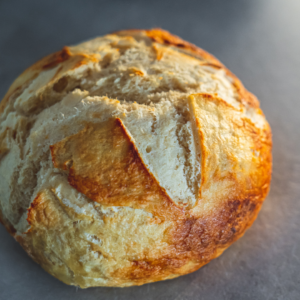
My first sourdough starter predated lockdown by about a month. It was right around the time I started grabbing a few extra non-perishables at the store, laughing at myself when I mentioned it to my friends—just humoring my nerves. Because as the news stories piled up and, more alarmingly, as I started to overhear other people talking about it too, it was soothing to look in the cupboard at the extra cans of tomatoes, the bags of dried beans.
And the bags of flour, of course.
What sold me on it was the simplicity. Unlike making beer or kefir or kombucha or cheese, you didn’t need to track down or order a specialty ingredient—or worse, ask someone for some of theirs. I’d owned enough plants in my adult life to be wary of my ability to keep even the simplest of living things alive, and the thought of breaking the news of a starter-child’s untimely demise to my generous coworker … that was deterrent enough. It was only later, in February 2020, that I realized I could do it myself: all I needed was water and flour.
That’s also what appealed to me about writing. You just needed a scrap of paper, something to write with. I didn’t have to beg my parents to buy me anything; I didn’t have to mention it to anyone else at all. The summer I started writing was the first one I didn’t tan; no longer reliant on the neighbor kids to play out narratives with me, I self-isolated in the basement, powering through the stockpile of yellow legal pads in the drawers of my dad’s desk.
I’d cut my teeth on pandemic-style thinking with apocalyptic writing that over the years has gotten increasingly interested in crafting—something I try to limit, since it often involves far too much research for a first draft. “No one will care,” I’d tell myself as I continued to skim through a PDF someone put up on their webpage ten years ago about how to build a wind-powered generator from scrap on the cheap. Or leaning back to consider what might be used for a feasible psychological alternative to coffee or tea once that runs out (something common and aromatic—pine needles, maybe? what would that taste like?). But a part of me feels like those details are important, even for the draft; that they might steer the narrative in subtle ways, or keep me from catching myself in a logistical snare down the road.
Though my anxiety certainly didn’t need the validation, I was grateful I bought that extra flour in February. And when I think back on all the strange rabbit holes I’ve gone down in my crafting research, I don’t regret any of them either. Not only for the depth they’ve added to those stories, but because when a friend idly wonders how hard it’d be to power their off-the-grid lean-to, I happen to have handy a link to that PDF.
I still haven’t bought bread since I started making it.
That doesn’t mean I’m any good at it. I never got as deep into the bread baking as my friends did: perfecting the hydration, the rise. Their golden loaves, sliced to show off the open crumb, would pop up on social media, and I’d maybe ask for tips or try their recipe. But I still haven’t sprung for the Dutch oven, and I can’t bear to actually throw out any of my starter to make sure it has the right oomph. I’ve rarely tried to make more than one loaf at a time to troubleshoot, and honestly, I’m probably never going to even buy bread flour.
I think my interest in breadmaking is closer to the core of the larger societal impulse toward it: that desire to get closer to the root of the food production process when faced with empty shelves, to wrest control from the power structures that have proven unreliable. An urge toward self-reliance. I understand how the perfectionist streak honed among my generation could steer one to obsess over creating the perfectly Instagramable loaf. But I’m more interested in doing the least: just how much farther down can I trace the supply chain? What is the bare minimum? It was an exercise I had already practiced ad nauseam thanks to writing disaster/post-apocalyptic fiction.
Flour, for example: it’s just ground wheat, right? So wheat and a mortar-pestle setup should do it. What do you need to grow wheat? I’d ask myself when I struggled to find flour in the store for the second week in a row. And how much wheat produces how much…? —the rough conceptualization, mentally mapped over the dimensions of my city porch, cut off the idea of trying it out myself. Suffice to say, you’d need land and time. Also skill and work—or luck, which is easy enough to write in, but much harder to come across in reality.
Water seems a bit more obvious. Despite some concern early in the pandemic, I never had to go past turning the tap and waiting for it to get lukewarm. But we’ve seen that method fail in less era-defining disasters, and just in particular communities for years with no end in sight. In recent years, even before the pandemic, there’s been a small voice in my head telling me to relish the feeling of water flowing freely from the tap over my hands (the same voice that told me to fully appreciate the experience of sitting at the counter of a local diner in the weeks leading up to lockdown), because it isn’t convinced we’ll always enjoy that luxury forever.
Apocalyptic fiction often skates by the issue with a mention of rainwater collection before moving on. Perhaps the characters have to watch for the rain, scrambling to put out their buckets when it arrives. But there’s more involved here too: how exactly you’d divvy it up to drink, wash up, clean, do dishes and laundry (not to mention washing your hands for two full renditions of ‘Happy Birthday’). Even growing up in droughts in the Western US, water conservation meant little more than turning off the sprinklers for a few weeks. But coincidentally, in the summer of 2020, I came across a series of interviews with seniors from upstate New York in the eighties, one of whom waxed nostalgic about how her mother saved the excess water from rinsing dishes to pour in the garden and used the soapy kind to wipe down surfaces outdoors. You’d need not just collection receptacles, I realized, but careful organization, thoughtful tiers. It’d require a massive shift toward mindful usage that most of us have only maybe given half a thought toward while camping. Just enough generations have passed since anyone bothered to make it a habit that we’ve all but forgotten it was ever the case.
Salt poses the biggest problem. One I was already familiar with, thanks to one of my rough-draft deep-dives. A memorable one because I never came across a great answer for it while looking for a salt source in the Midwest, where I had a story set on an island in the Great Lakes and mentioned, offhand, salted fish as part of a lunch. Fish from the lake, of course. Salt though… Suddenly I was a dozen browser tabs down a Google search, trying to suss out from the first pages of JSTOR articles on precolonial America if there was a feasible source to tap or if it was indeed exclusively procured through trade with coastal tribes.
The ocean, the obvious source, was so seductive I thought about moving the story entirely—that impulse toward self-sufficiency again. This, despite the fact that the story was also set just long enough after the apocalyptic event that I’d imagined multiple microsocieties settling in, developing certain cultural distinctions, and even starting to lean into political alliances. Because a trend I’ve occasionally spotted in recent apocalyptic fiction is the move toward depictions of larger communities rather than the sole survivor, the ragtag group, the isolated compound. And I’ve become more interested in the idea of a nascent trading network than a few hardy scavengers going after a grocery store that, we just all learned, could well have been wiped out of the essentials in a day at the first whiff of trouble. (It might be more realistic if the characters were snatching up the expensive specialty items that we were more able to find still sitting pretty on the shelves a week later—the paleo chocolate, the gluten free pasta.)
And yet that pull toward making the island feasible as a closed environment was so strong. The same way I sometimes catch myself reassuringly remembering the time I made bread without salt by accident, and that wasn’t so bad, was it? (It was edible anyway.)
When I mentioned the breadmaking to my dad, over the phone early in lockdown, he laughed. To him, baking bread was very ‘Suzy Homemaker’—an abrupt detour into traditional housewife territory for a daughter who didn’t own a pair of heels. I don’t think he really understood it until I carted the starter across the country, on a road trip with my dog in the fall of 2020, and made bread in his Denver kitchen before I continued west. To save money and dodge COVID, I was camping between stops to see friends and family and bringing all my own food, and the little loaves of bread were a big part of my road diet.
“No sugar?” He was surprised, and I affirmed: “Just flour, water, salt.” And though he’d all but sworn off bread, he finished the loaf I left him with before I reached Salt Lake, saying it reminded him of the bread his aunts used to make growing up, “hard on the outside.” (My crust is up to someone’s standards, at least.) He asks me to make it now every time he comes to visit, and I’ve loaded up the starter in the car on the many road trips since, securing it safely in the cooler like a second pet. I once realized I’d left it behind a quarter of the way into a fourteen-hour drive and seriously contemplated going back for it before I called my dad to break the news.
I’m not sure I’d have stuck with breadmaking this long if it hadn’t become such a staple of my road trips, both as something easy to eat when I otherwise might just split a Twix bar for dinner/breakfast and as something I can impart on whomever I’m off to see.
That push and pull between the survival and communal aspects of food is something apocalyptic fiction has maybe always gotten right. By virtue of the scarcity of it, sharing becomes more emotionally charged. It’s why one of the first things I did when I started making bread was bring some to my friends—holding my breath as I pulled it out of the oven and jostling it straight into a bag from the cookie sheet without touching it—even though flour was scarce and I half suspected that despite my precautions, my friends still might secretly throw it away to be safe.
Though the apocalyptic stories we most often see glorify the lone survivor, the one who can make it all on his own (because it’s usually a him, right?), that ‘going it alone’ is never the real story. He’ll meet a woman, a child, a comrade and will probably form a motley band of misfits because humans gravitate toward each other. But the idea that you only need a pod like that to get by is, I think, the flaw we’re seeing exposed now. One of the things I missed more than I’d have thought over the past two years has been those more casual relationships: friends of friends, acquaintances, even just strangers at the bus stop. A few months into 2020, I found myself chatting at length over email with the owner of a candle shop, desperate for that nearly anonymous small talk you only make with people who know nothing about you. Or, a year later, the utter thrill of putting the pieces together the first time I hung out with a group I only know through one mutual friend we share, sitting with a beer in his backyard and putting the pieces of the conversation together to infer who had broken up, or moved to the suburbs, or changed jobs.
When we talk about how humans are social beings, we think more about how we need friends and family than that craving for a larger sense of community. And I think because of that blind spot, much of apocalyptic fiction has vastly underestimated how quickly those networks would build back up again, and thus lost the opportunity to examine what that might look like. Because sure, you can make bread without salt, but by god, at what cost?
S. L. Martin is an editor in Philadelphia who enjoys backpacking, mucking around with her dog, and asking friends about their postapocalypse plans. Her short story “Morelle and Vina” was published in Wings of Renewal: A Solarpunk Dragon Anthology in 2015.